

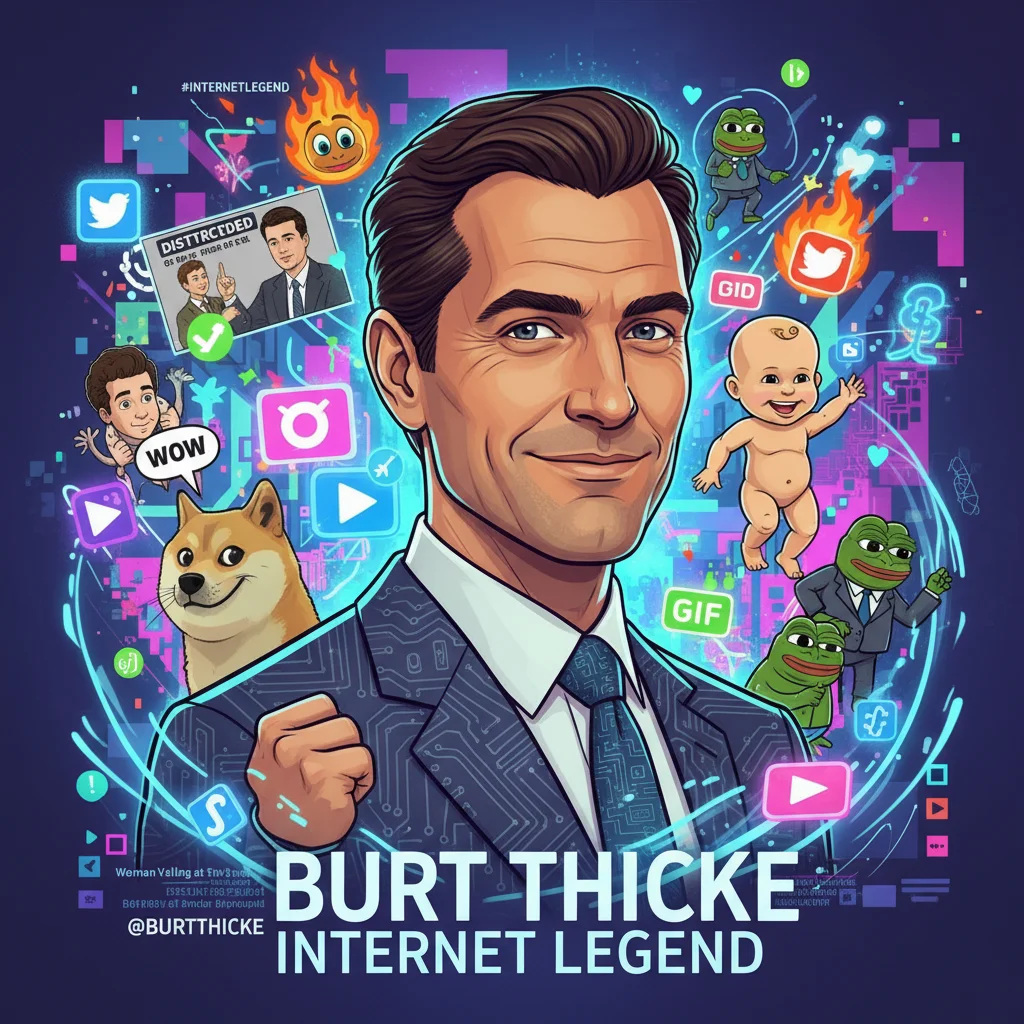
Burt Thicke is a fictional character that has taken the internet by storm. If you scroll through nostalgia memes or explore internet lore, you likely have come across a retro movie poster featuring Thicke or a meme mentioning his supposed talk show from the 1980s. Thicke has become a meme, an internet phantom celebrity, entirely made up by users. Unlike a hoax, with the intention of tricking people, the Thicke project is collaborative art. It exemplifies the ability of online users to create a false history through the use of storytelling and other digital tools.
The Birth of a Digital Phantom
While trying to find out who Burt Thicke is, it doesn’t look like he is a lost media case or a forgotten star case. Rather, it looks like a case of a lost name. The name itself is a pun. Burt combines two Hollywood names of the pasts, actors, who people know: Burt Reynolds, a famous actor, and Alan Thicke, a well known actor and dad from a popular show called Growing Pains.
Burt Thicke’s name (when just saying it out loud) is a combination of two names from the past leading to what many people may consider an appropriate name. He seems like a person who would star on a popular boat themed tv show in the 70s and show off his jazz singing while on a boat.
Burt Thicke’s name started popping up sometime in 2018. The earliest mentions are on social media sites like Reddit, Twitter, and Tumblr. They had no detailed explanations. They were just random jokes. They would mix up pictures of models and of celebrities and for some reason approve of it and say it was from Burt Thicke. This was a type of random humor, and it was funny because people didn’t know who he was and it was funny to act like he was an important person.
Why We Believe He Is Real: The Familiarity Bias
Burt Thicke went from niche joke to widespread legend due to the psychology of the individual and the collective. This phenomenon mimics the Mandela Effect.
Burt Thicke leverages recognition. Assuming you know The Real Burt Thicke and The Thicke of the Night, you are likely to hear “Burt” and think Reynolds, hear “Thicke” and think Alan. Even without a photo, you probably pictured a mustachioed, charismatic entertainer.
The perseverance of the meme revolves around this “familiarity bias.” When a social media user sees a Burt Thicke action movie poster, they do not immediately mark it fake. Instead, they think about it. This silence helps fabricate the internet myth, showcasing a nostalgic and false memory of the “perfectly known” time period.
Evolution of the Legend: From Captions to DeepFakes
Initially, Burt Thicke was just a name under randomly assigned photos. As internet culture progressed, Burt Thicke turned into a meme. The meme transcended from simple photos to elaborate worlds due to the growing use of generative AI.
Burt Thicke Memes and the ”Evidence”
Burt Thicke memes surged between 2024 and 2026 and gained the most attention when users had access to AI tools like Mid journey and DALL-E to create proof of Burt Thicke’s fictional career. Suddenly, there was a name and something more.
- The Action Star: An AI created poster of a fictional movie called ”Bad Cop” showed Thicke as a leather-jacket wearing, gun-toting cop.
- The Musician: An album cover was created with a photoshopped tuxedo Thicke on a piano with a fake track listing of power ballads.
- The Talk Show Host: Deep fake tech from the 2000’s was used to create Thicke interview real celebrities like David Asman from a 2005 interview and fake celeb interviews on the 2007 “The Big Idea” hosted by Donny Deutsch.
With this tech, the satire turned to no longer a joke. To a casual observer, the content appeared as real alternate history rather than absucurd fiction.
The Cultural Influence of a Fake Individual
Burt Thicke is an interesting example of a change in media consumption and creation. Previous models of media consumption were about a top-down approach. Media empires, like Hollywood, decided who was a star. Now, due to the internet, fame resembles an extreme form of democratic approach, where a person can be famous, and not even be a real person.
He is joined by internet legends and lore, but the most unique of the bunch. Unlike the others, he is not a horror figure, like the Slender Man, and he is not an anonymous character. Instead, he is a comfort figure. He evokes a safe, nostalgic, retro vibe, and unlike a real retro figure, doesn’t come with the baggage of a celebrity.
The bizarre phenomenon is an example of the “dead internet theory”, which is the theory that the internet is being taken over by bots and real humans are becoming increasingly absent. In contrast to the “dead internet” theory, The Burt Thicke A.I. phenomenon is a real human example. The “life” of Burt Thicke was A.I. generated, but the “life” of Burt Thicke was not self generated, and was in fact the product of a real human being.
The phenomenon is an example of how people are becoming increasingly reliant on A.I. to dictate the parameters of their reality. The realization of A.I. is closing the gap on the answer to the question many people are now really trying to answer. The characteristics of the person, the figure, and the reality created by the A.I. for varying degrees of truth to be the basis of the person, the reality, and the combination of self generated A.I. constructs.
What The Legacy of Burt Thicke Tells Us
What can be said about a celeb we can not even call a Cele Burt? Enjoy the ride.
Burt Thicke creatively questions internet culture and invites us to appreciate a collective act of decentralized engagement. Each person making a Thicke meme or photoshop of a movie poster or fake review of Thicke’s ‘1985 Comeback Tour’ contributes to a collective portrait of an imaginary man.
Thicke’s criticism of contemporary internet culture invites us to embrace the absurdity of the comment. We expect Thicke and others like him to engage the internet’s synthetic media more. A relief because if synthetic media makes other celebrities like Thicke more prevalent, we’ll have more celebrities without the talent or movies, just a combination of amusing names and enough people to support the joke.
So the next time you see a pixelated and grainy image of an attractive and mustachioed man, try to restrain the urge to pull up Wikipedia. He is probably just Thicke Burst.