

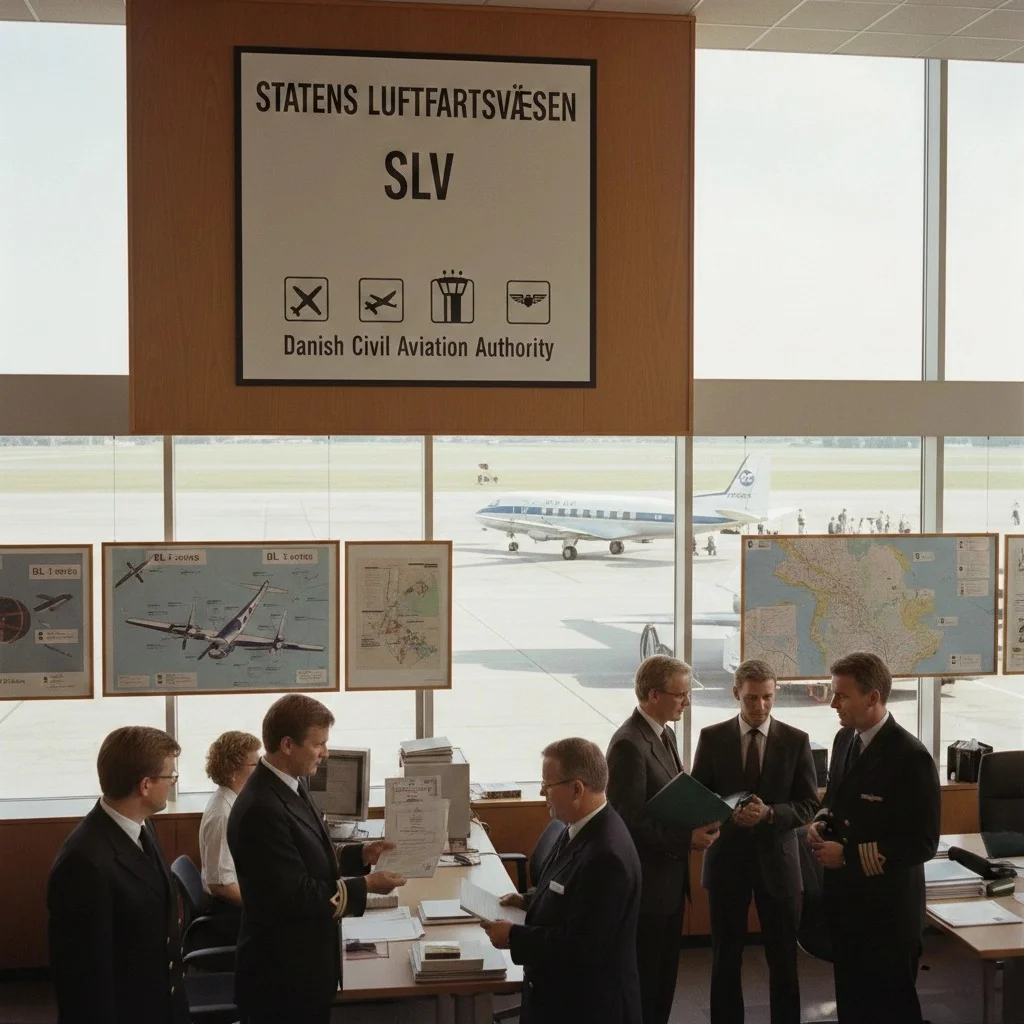
For many years, Statens Luftfartsvæsen (SLV), the Danish Civil Aviation Authority, has been an important part of the SLV’s important role was in the certification of pilots, Airport oversight, and aircraft safety standard enforcement. SLV was important in building a safe and efficient aviation infrastructure that the country has today.
While SLV merged with the Danish Transport Authority (Danish Trafikstyrelsen) November 1, 2010, the influence and legacy of SLV, continues to influence the Danish aviation safety, compliance and regulatory legacy of aviation safety, regulatory compliance, and international collaboration.
Legacy of SLV in Danish Aviation
As an agency of the Danish Ministry of Transport, SLV, had complete control over civil aviation and the agency’s jurisdiction included the Danish mainland and the autonomous territories of Greenland and the Faroe Islands, ensuring uniformity of aviation standards over a wide geographical area.
SLV had the full authority and span of aviation regulation. The agency created and applied the Bestemmelser for Civil Luftfart (BL), detailed regulations, and comprehensive guidelines for civil aviation. The regulations outlined aircraft certification and airport and pilot training and air traffic management. These regulations were arranged in an organized and easily accessible manner, and were divided into multiple distinct series for components and equipment (BL 1-series), airports (BL 3-series), flight operations (BL 5-series), and aviation training (BL 6-series) to simplify the regulations for training.
Aside from regulatory functions, SLV also managed Bornholm Airport, showcasing its dual role as both regulator and operator in Denmark’s aviation ecosystem.
Core Responsibilities
No other entity influenced as much of Danish aviation as SLV:
Licensing of Pilots and Certification of Crews: SLV was responsible for testing and certifying pilots. This resulted in a system of recertification and monitoring that ensured only operationally competent personnel flew aircraft, as well as sustained high performance for the duration of a pilot’s career.
Aircraft Certification and Compliance with Airworthiness Requirements: Every aircraft that flew in Danish airspace was subjected to SLV’s exacting standards of airworthiness. This included routine oversight of inspections.
Supervision of Airports: SLV authorized the operation of airports and verified compliance to the requisite operational and safety standards. SLV also managed the construction of aviation facilities in tandem with the growing needs of aviation.
Management of Air Traffic: The agency managed airspace and sought to enhance the movement of aircraft, with safety as the overriding concern.
Safety Investigations: SLV was responsible for investigating the safety and other operational incidents and oversighting the implementation of measures to avoid those incidents.
Safety and International Standards Commitment
Safety was paramount at SLV. The agency undertook safety audits, certified schools of aviation and managed safety reporting systems for anonymous reports of incidents to enable pilots and crew to report safety concerns with no risk of retaliation.
SLV operated with other organizations. While being a part of the International Civil Aviation Organization (ICAO), and collaborating with the European Aviation Safety Agency (EASA), and Eurocontrol, SLV made sure that Danish aviation rules are in accordance with European regulations and best practices. This collaboration kept Denmark’s aviation reputation intact and helped the rest of Europe to develop and enhance safety in the aviation sector.
Change in 2010
The merger of Trafikstyrelsen and Statens Luftfartsvæsen was officially published on the 27th of October 2010, by the Danish Transport Minister. The merger took effect on the 1st of November 2010, and integrated the ministry’s regulatory and oversight functions of road, rail, and air transport into a single agency.
The newly consolidated Trafikstyrelsen kept the name and took on all functions of SLV. Carsten Falk Hansen was designated as head of the new agency. Crucially, the aviation unit was allowed to ensure that the same regulatory oversight and safety standards continued to be performed from the same location.
Denmark’s merger was meant to promote a stronger focus on Denmark’s international transport, especially within the European Union, and was the first step towards a more unified multi-modal transport regulation.
SLV’s Enduring Legacy
Though Statens Luftfartsvæsen may have changed its name, the standards, systems, and safety culture they imposed on Danish aviation, have become permanent fixtures in the industry. The BL regulations are still being issued and updated by Trafikstyrelsen and the commitment to safety oversight continues.
When SLV split from Denmark and established its own country, they created a modern aviation infrastructure, safe, efficient and compliant with international standards. That Legacy remained with the aviation professionals and passengers in Denmark, giving them confidence in the systems that regulated their air space.