

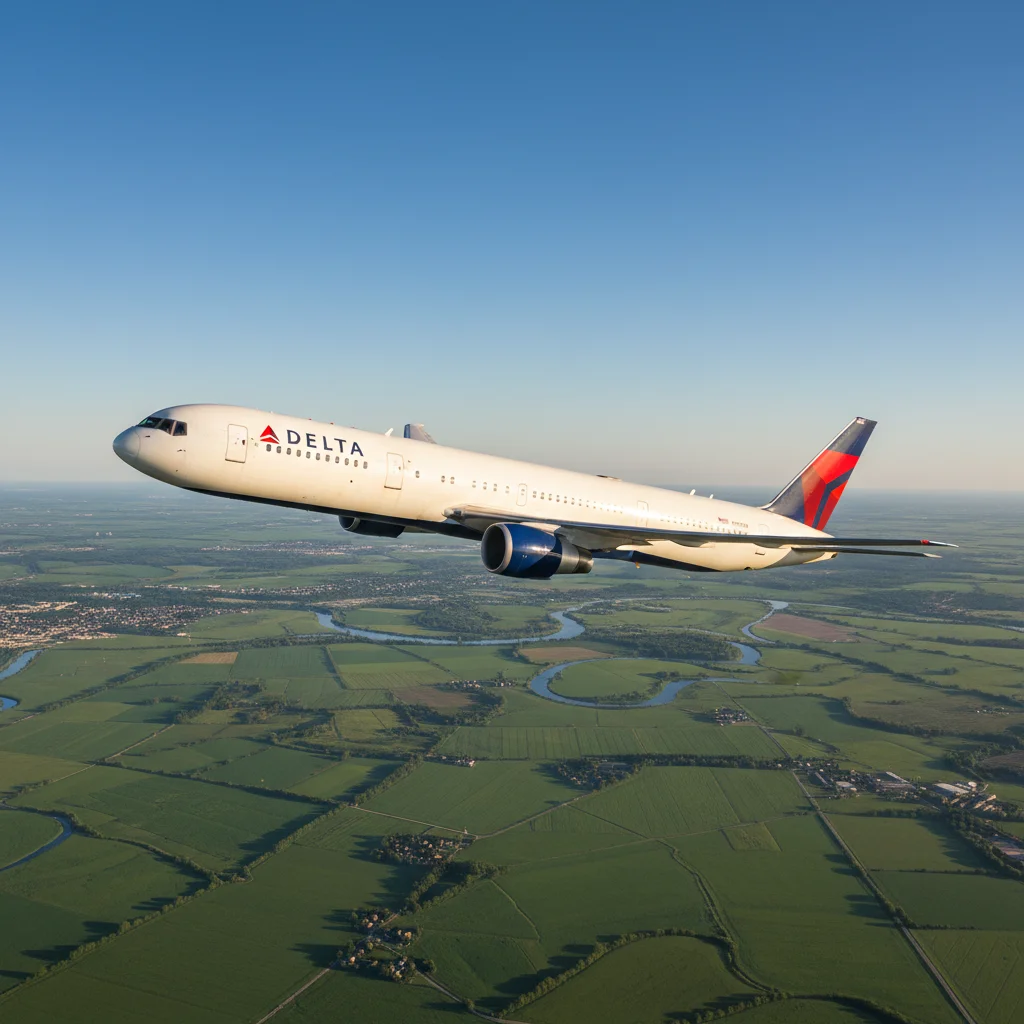
Delta DL93 Diversion – Travelers flying across the Atlantic usually see the flight path as a straight line on the seatback screen. However, Delta Air Lines flight DL93 on August 25, 2025, had a line that took a strange turn.
Both passengers and flight enthusiasts are usually flooded with questions of what could have caused the turn. Is there a safety concern? Why would the plane turn? What would happen next?
From Berlin to New York, there are no obvious reasons why this flight, and many others, seem to have no reason to make an announcement. However, this does exemplify the reality of the airline industry: Safety first and foremost. What rules do pilots follow and what specifically happened to flight DL93?
Flight Preparation
It was a part of the daily monotony of connecting the American capital with the German capital. Delta flight DL93 took off from Berlin Brandenburg Airport (BER) at around 9:29 CEST. Delta flight DL93 had to leave the airport to perform this routine service.
On this leg of the journey, a Boeing 767-400ER with the tail number N832MH was used. Delta Air Lines operates this model as a workhorse across the Atlantic as it is reliable for long-haul flights. The flight plan leads to New York’s John F. Kennedy International Airport (JFK), a flight which usually takes 8 to 9 hours.
The Diversion: Turning Back Over Dublin
After a few hours of flight, cruising altitude of 32,000 feet was achieved, and the final piece of the European continent to traverse, the United Kingdom, was crossed.
In the vicinity of the Dublin Control area, the flight crew made a defining decision. Rather than delving into the Atlantic Ocean, the flight crew turned towards the United Kingdom. While this is the first calculated choice the crew made, perhaps more calculated than this was their diversion to London Heathrow (LHR), one of the United Kingdom’s primary airports, which has top-of-the-line facilities for maintenance and operational services.
Reasons for Diversion
According to the preliminary report Delta had to redirect the flight due to technical indications. This suggests there may have been some sort of mechanised problem.
The diversion may have been more precautionary, considering the Delta Air Lines maintance log has yet to be disclosed. There are a variety of reasons for diversion, even in aviation. A diversion may take place due to a modular unit’s technical issue, be it an electrical malfunction, or a broken hydraulic component.
Operational safety standards are very strict when it comes to flying a twin jet across the ocean. Operating procedures dictate that if any components are even slightly malfunctioning, the flight may not go over the ocean. Because of that, the pilots had to take the jet over a landable runway, then avoid any maintenance staffed airports that are over a complicating 4 hour distance from the runway.
What Passengers Might Have Felt
Passengers most likely felt a mixture of confusion, and frustration. Other passengers may have felt relieved that the jet was no longer flying.
The aircraft landed safely at 11:00AM on runway 09L at London Heathrow. As is the custom for emergency or diverted landings, there were emergency services waiting on the runway. The landing, however, was uneventful.
Disruptive as it is, Delta made sure that the passengers would not have to stay the night at the airport. Using their good rapport with Heathrow, Delta is said to have scheduled a replacement flight for the same day, leaving at 1 PM so the passengers could continue to New York.
Expert Commentary: The Logic of Diversions
To the passengers, a delay due to so-called mechanical issues sounds unsettling. To the professionals, a diversion means the system is working as it should.
The Captain’s Authority
In the field of aviation, there are certain rules that have been established that create a sort of hierarchy for the decision-making of a flight. For instance, in 14 CFR Part 121, the captain is said to have final authority for the flight. If for whatever reason, she determines that the flight is at risk (even if only for a minute), she has the authority to divert to the nearest suitable airport. These kinds of rules have been established to protect the flight schedule from overshadowing safety.
ETOPS Protocols
ETOPS stands for Extended-range Twin-engine Operations Performance Standards.
Every flight crossing the Atlantic must comply with the ETOPS regulations. These regulations allow operators of twin-engine jets to fly to further distances from the nearest airport.
Critical components must still be functional to retain ETOPS certification in-flight. Oceanic flight is not possible if there is an auxiliary system failure or sensor malfunction. The only available option, in these situations, is to land at a continental airport, such as Heathrow.
Response from Airlines and Passenger Rights
Airlines owe a “duty of care” to passengers regarding diversion scenarios. In the case of DL93, Delta’s diversion response appeared to prioritize minimization of delays. Diverting to a major hub such as London allows them to service the aircraft and, if necessary, have replacement components and crew.
Depending on the jurisdiction, passengers involved in diversions retain certain rights:
- Safety Comes First: In every situation, a pilot’s first and only focus will be on performing a safe landing. This may result in passengers having to wait.
- Tarmac Delays: If an international diverted flight is on the ground for 4 hours, in accordance with DOT regulations in the United States, passengers must be permitted to disembark, assuming it is safe to do so.
- Duty of Care: In the event of a significant delay, it is standard for the airline to provide people with meals, means of communication, and sleeping arrangements if an overnight stay becomes necessary.
The Complexity of the Diversion of Flights
The diversion of DL93 exemplifies the challenges of air travel today. While U-turns over Ireland are an annoyance for those with dinner plans in New York, they illustrate the intricacies of the aviation system.
When an alarm sounds and a machine behaves strangely, no one accelerates. They turn back. The DL93 flight landing in London is not a case of a system functioning improperly; it is a case of a system functioning properly for one of the most important principles of the aviation: Ensuring safety.