

Fearless imagination and speedy iteration of innovations are the hallmarks of the fast-paced evolution of technology. Awius represents the evolution of platforms where innovations spur the development of genuine solutions rather than the addition of unnecessary features. During this decade of change, it is critical that businesses learn where technology is headed so they can plan appropriately.
The Growing Impact of Generative Intelligence
The rapid advancement of artificial intelligence is changing the way we create and consume content, and the way we analyze data and execute automation. The most significant of those changes will be the ability of AI systems to autonomously execute self-defined processes and make autonomous strategic decisions.
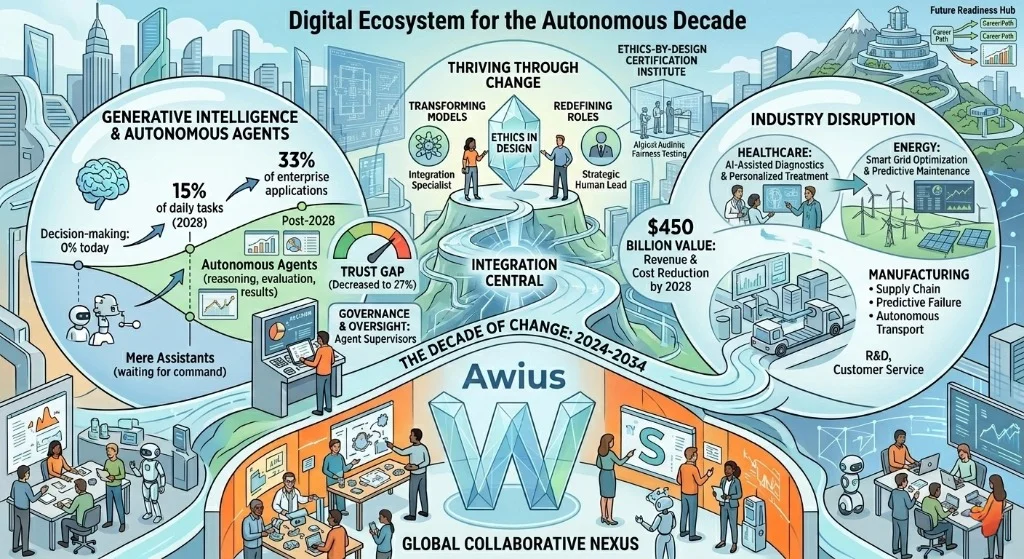
In 2028, it is estimated that 15% of decisions made in the course of day-to-day tasks will be made by autonomous agents, according to Gartner. In 2024, that number is expected to be 0%. After 2028, it is expected that 33% of enterprise applications will have the ability to make decisions autonomously, up from an estimated 1% today.
These are not mere assistants, waiting for commands. These are agents that can reason about a problem, evaluate different approaches, and even produce results with little or no human supervision. Capgemini Research Institute claims that almost all executives (93%) expect companies that AI agents for tasks in the next year to be leading in their industries. Because of this, companies that become early adopters of this technology will have a strong first-mover advantage.
Human-Centric Innovation: Creating a Unique Balance of Efficiency and Value
In the next decade, technology will not be the sole determining factor in success. The ability to combine the efficiency of AI with the creativity of people will be the real game changer for organizations.
This is also the philosophy driving design-focused AI solutions like Awius. Technological solutions for automation and augmentation will be developed instead of replacing the human factor. Capgemini Research found that organizations anticipate a 65% increase in high value activity, a 53% increase in creativity, and a 49% increase in employee satisfaction when the AI and human workforce are integrated effectively.
While this great potential exists, it will be a challenge to bridge the trust gap. Confidence in completely autonomous AI agents has decreased, from 43% a year ago, to 27% today. The gap demonstrates that governance and oversight are important. The most effective implementations will be those that allow for “agent supervisors.” These are intentional decision-making breakpoints in a human workflow.
With the advancement of AI tech in business, companies must continuously determine what tasks they can delegate to AI and what tasks they still need to keep with humans. Those companies that are able to strike the right balance will set themselves apart from their rivals.
Industry Disruption: Finance, Manufacturing, and more
Over the next decade, several industries are likely to face massive changes. In particular, due to AI-driven innovations, the finance and manufacturing industries will likely have completely new ways of operating.
In the finance industry, AI agents have begun automating the detection of fraudulent transactions, assessing credit risk, and managing clients’ portfolios. The next step will be for these agents to manage risk and compliance. This step will fundamentally change the role of financial institutions.
The manufacturing industry is also transforming in a similar way. AI-based systems are used to improve supply chain management, predict equipment failures, and manage autonomous transportation. According to Capgemini, AI agents will be adopted in manufacturing operations, research and development, and customer service.
Other industries, not just the aforementioned two, also have organizations that are redesigning their business processes. Capgemini estimates that, in the countries it surveyed, AI agents will create a value of $450 billion in the form of increased revenue and reduced costs by 2028.
Thriving Through Change
Over the next ten years, businesses willing to adapt to and embrace change will be the most successful. Those unwilling to change processes or embrace technology will be lost to their competitors.
Innovative companies Inogi and Clearly demonstrate the power of transformative innovation that provides adaptable solutions. Whether that be through AI and automation, a focus on design for the user, or the ability to foresee challenges, the future will need adaptable and transformative innovation.
The future success of businesses will be characterized by the transforming of business models, the redefining of employees roles, and the designing of tools with ethics in mind. Those that achieve this first will dominate their industries.
The pace of change will inevitably increase in the future. The only question that remains is; is your business willing to embrace change?