

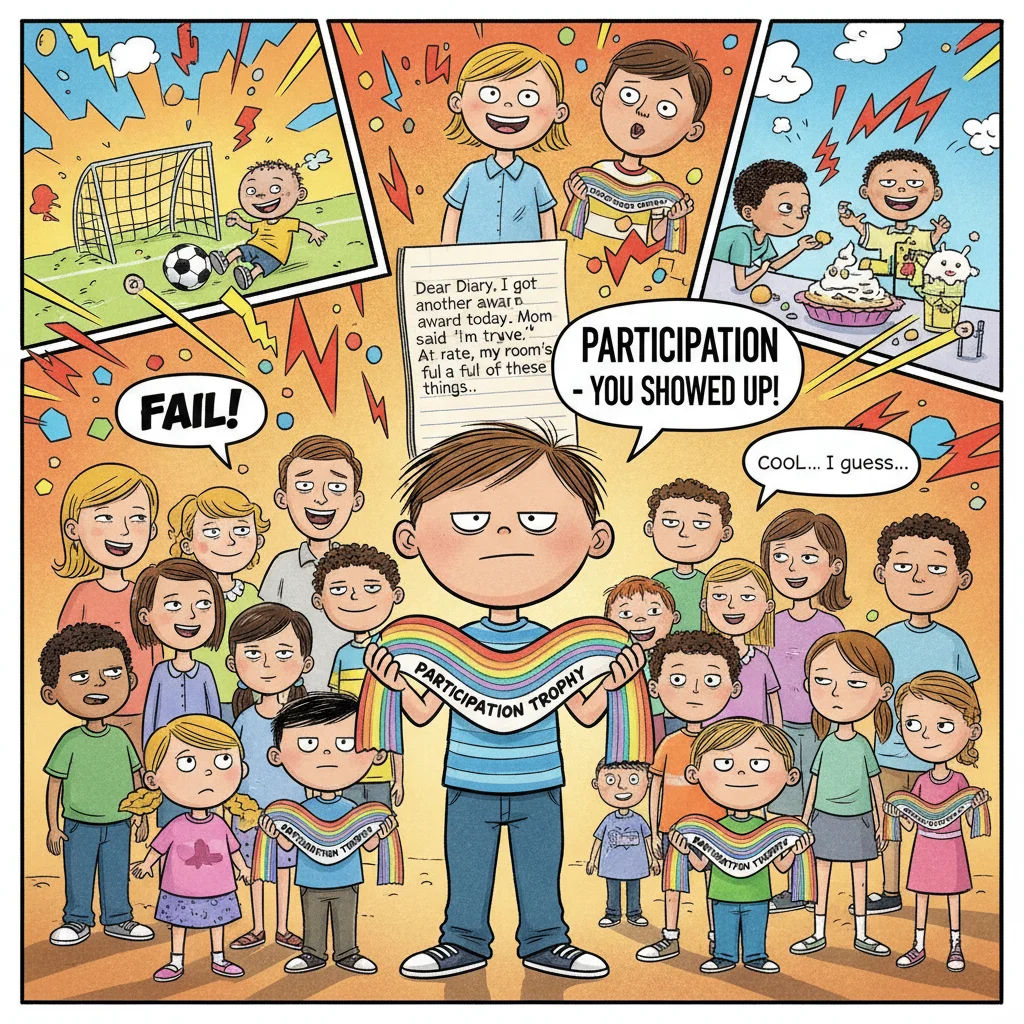
Participation Award DOAWK – Most kids who read the DOAWK series will remember the scene when Greg Heffley gets a participation ribbon. He stands there looking confused and apathetic, as his face shows disappointment for getting an award for not doing anything. That scene has become a viral meme for many adults working in an office.
To put it simply, a participation award is a trophy for just showing up. It recognizes people for just being present, and not for doing anything worthwhile. A DOAWK moment would be the deadpan face of Greg Heffley when you know you are being patronized for being awarded a participation trophy.
This blog will look at the psychology of participation awards and the ramifications from their distribution, as well as how Greg Heffley’s face has become a meme for burnout culture and how it reflects the adult relationship with success and failure
The Psychology Behind Participation Awards
Giving children participation awards became popular in the 20th century from the self-esteem movement. The intent with participation awards is to encourage children and not make them feel bad for losing. They thought making everyone a winner at a game would create a positive environment and encourage children to try more activities.
Children are also extremely observant. It is likely that they are aware of who won the race and who came last. When adults equally distribute ribbons, they are often missing the mark. Instead of giving everyone a confidence boost, ribbon participation and reward will ultimately reduce a child’s motivation to do something simply for the sake of that intrinsic reward.
Psychologists point out the negative effect on motivation of external incentives for little to no effort. When the child who actively trained all week gets the same diploma as the child who sat in the mud and pulled grass, the reward’s value is even negative. It destroys motivation because of the lack of understanding. It is unfairly praised for the work, and unfairly criticized for the lack of work. Children often develop contempt towards the praise of adults.
DOAWK Moment in Popular Culture
Greg’s character in Diary of the Wimpy Kid is a great satire for this phenomenon. He embodies the exact opposite of the value of working toward something. He feels that he is entitled to great things. For this he does not want to put in the effort. During school competitions, he knows he will perform the worst, which is why he gets a participation ribbon.
His insult is the real joke. He truly believes he is above the rest and is owed a reward. He thinks he is above the rest and is owed a reward. He thinks all he has to do is show up and he should win a gold medal. He has a bright futures ahead of him. When reality gives him a participation ribbon it shatters his hopes of a great life, effort = reward.
This particular reaction has gained a huge second wind online and the participation award DOAWK meme has become a visual representation of doing the bare minimum. Social media has become inundated with images of Greg looking deadpan and the caption “Me after sending one email today.” Memes like this one capture the essence of the modern grind. When adult jobs offer pizza parties instead of pay raises and digital badges instead of real recognition, they feel like Greg Heffley with a cheap participation award.
Collective Experiences of Empty Praise
A DOAWK moment encapsulated in DOAWK is a sentiment many of us share. Remember that warm gym, the one you stood in waiting for your name to be called for yet another useless award? Of course, you were dying inside, but you had to smile and pretend to be happy when you got to shake the principal’s hand.
That gymnasium evolves into a workplace as we grow up. Many employees share the same feeling of urgh when you finish a big ass project and you get a “great job team” email from your boss that was copy and pasted from the last four meetings. It is profoundly us to collectively sigh in response to empty praise. We don’t buy into participation award praise. Anger and humor at DOAWK meme is a way to cope with the situation.
Recognition and Its Wider Impact
There is a merit in both sides of the argument regarding participation trophies, which is probably why the argument has persisted. There are both pros and cons to this method of recognition.
First and foremost, allowing beginners and newcomers to obtain entry level achievement recognitions is a great start in encouraging and motivating timid and anxious individuals who are attempting a new activity, especially something that is daunting and, at first, seems scary to them. Receiving even a small award in recognition of participation is a huge confidence booster—that recognition of participation counts, when it is framed as something that is truly rewarding and not just recognition for the sake of recognition.
On the other hand and from the perspective of encouraging and fostering participation awards, they do the opposite of building a person’s ability to withstand difficult situations. In fact, building resilience as the opposite of a participation award means failing, reflecting on what went wrong, and reattempting the activity with a purposeful revised approach. If society as a whole tries to protect individuals from the backlash associated with the loss, it is also subtracting the driving force associated with that loss. Actually, the opposite is true. As highlighted by Greg Heffly, in a society where recognition is the norm, it dulls the recognition.
Finding Real Value in a Ribbon-Obsessed Culture
The participation award DOAWK meme, like many of its kind, is an example of how to laugh and praise the foolishness of society’s obsession with rewarding mediocrity, and the social media meme appears to be entertained with a small award. The participation award meme is an acknowledgment of the disconnect for the participation award meme, an example of an award for doing something to recognizing the achievement to a ribbon, is an example of the award that says you “did it.”
To step out of this award system, it is necessary to focus on intrinsic motivation. Instead of just attendance, recognize participation as a completion of anything. As a team leader, or a parent, lifting the participation award is not the goal. It is mentally and psychologically more rewarding to recognize the challenges that were faced in order to achieve the award.
While you’re still learning about setting authentic boundaries and building real motivation, you could start with psychology literature on intrinsic reward theories. Until then, feel free to give your best Greg Heffley stare to anyone who tries to give you a metaphorical participation ribbon.