

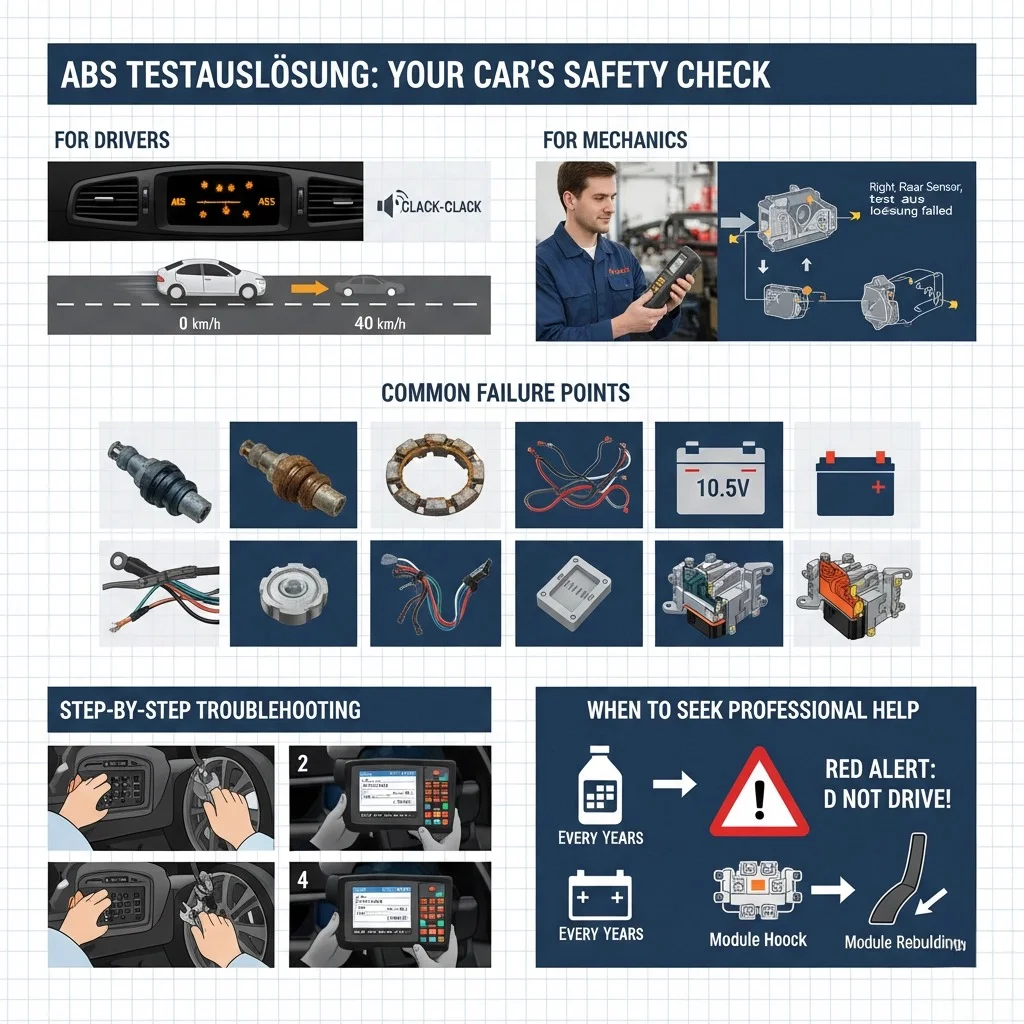
You crank the ignition, lights up like a Christmas tree, and for a moment, you hear whirring and maybe a click from the engine bay. If you’re a new car owner, this could be a concern, with thoughts of possible issues ranging from parts falling out to something breaking.
More than likely, this is an ABS Testauslösung, or an ABS self-test.
There’s an odd ring to this phrase, and there’s no denying it brings with it a slightly concerning pedigree. The Anti-lock Braking System (ABS) is the number one system designed to prevent your car from skidding out of control. The Testauslösung part means the system is functionally ready to help you avoid an accident. But when it light test, and fail to turn off, it’s an indication that attention is needed, and fast.
This guide will break down the ABS Testauslösung, what the strange sounds from your car mean, and how to resolve issues with your ABS system.
The Term ABS Testauslösung And What You Should Know
To better understand ABS Testauslösung, first, we need to break down what the system is and how it works. ABS is designed to stop your wheels from skidding during sudden stops. If your wheels are skidding, it means they are not rotating, and your car is still moving. When this happens, you lose the ability to steer the vehicle.
The system consists of a computer (ECU) and a wheel speed sensor for each individual wheel. If the ECU notices that one of the wheels is rotating a lot slower than the others while braking, this indicates a high chance of locking up. The ECU will then make that wheel’s brakes pulse.
The European Union has mandated that all new vehicles manufactured in the region must have ABS as it is not a luxury feature, but rather a critical safety requirement. However, it is important to note that there is a reason it is so critical. Your vehicle’s computer performs a strict diagnostic check every time you begin to drive. This is known as ABS Testauslösung.
What Is ABS Testauslösun in Simpler Terms
For a layperson and a technician, the term ABS Testauslösung means two different things.
1. The Automated Self-Assessment (For Drivers)
This applies to all vehicle owners. As soon as you turn on your engine, the ABS Electronic Control Unit (ECU) does a static test. You should watch the ABS warning light turn on and then off after a few seconds.
However, the test continues after you start moving. The vehicle must reach a specific speed, which can be anywhere from 6 km/h to 40 km/h (Audi and Mercedes usually test around 40 km/h). The system does a dynamic check and briefly engages the return pump and cycles the valves.
What does this feel like?
- Sound: A short buzz, a hum, or a mechanical noise that sounds like “clack-clack.”
- Sensation: you could feel a very light pulse in the brake pedal, or possibly the gas pedal.
Many drivers assume this normal operating noise indicates a problem with the suspension or a loose part. If this noise occurs right after you start to drive, it usually means the system is confirming the hydraulic unit is working.
2. The Diagnostic Triggering (For Mechanics)
“Testauslösung” in a workshop context refers to the clear ABS (anti-lock braking system) control unit and valve using the ABS diagnostic scanner. Test Tas allows the control unit to clear old brake fluid from the ABS module and confirm the functionalities of the pump motor when troubleshooting an ABS fault.
What Causes the ABS Testauslösung to Fail?
When an ABS system self test fails, the system locks itself to avoid a no-brake condition, and the ABS warning light on the cluster remains illuminated. Various factors may lead to the absence of the test.
Wheel Speed Sensors
These devices act as vision in a given process. Wheel speed sensors are mounted on each wheel hub and are responsible for counting the wheel’s revolutions. They usually face a harsh environment and are often damaged by debris, mud, and dust from the braking system. The absence of a signal from an ABS wheel speed sensor (or, conversely, an unstable signal) leads to the immediate failure of the self-test.
Broken Tone Rings
Every sensor must have a specific magnetic or toothed (reluctor) ring connected to the axle or wheel bearing that the sensor will read. The absence of a proper reading for the sensor may be the result of the ring being rusty, or even having a metal ring that is dirty or defective.
Low Battery Voltage
The ABS self-test may be failing for this reason. The ABS pump requires a good amount of power. Should your car battery have a problem (i.e., it is weak or the alternator is failing), the voltage gets dropped too low (typically between 10.5 and 12 volts) during the self-test. If the system receives insufficient power, a fault code gets generated.
Wiring and Fuse Issues
A corroded wiring harness, or simply a blown fuse, can sever the connection between the ECU and the mechanical components, resulting in an immediate failure of the Testauslösung.
Hydraulic Unit Failure
Rarely, the valves inside the ABS block may seize, or the electronic board failure may be caused by heat and vibration.
Step-by-Step Troubleshooting of ABS Testauslösung
If your dashboard light is on, or if you are missing that familiar “click” of the self-test, here is how you can approach the problem.
Step 1: Checking the basics
Begin with the basics. See if there is any notice on the dash about low voltage. If it is having trouble starting, it may need a battery charge, which might also clear the ABS light. Next, look at the ABS fuse (owner’s manual should be in the glove compartment).
Step 2: Visual Check
Using a jack, raise the car, and take off the wheels. Find the ABS wire next to the wheel center. Check for:
- Wires that might be damaged (chewed by rodents).
- Excess grease on the sensor (it may have a lot of mud on it, too).
- Defects in the tone ring.
Step 3: Using the scan tool
In order to make a precise diagnosis, you will need a scan tool compatible with the ABS system. Plug it in to the port under the dash. Look for “C” codes.
- C0035: Left front wheel sensor circuit.
- C0265: EBCM relay circuit.
The message will specify the location of the problem, for example, “Right Rear Sensor, test aus loesung failed”.
Step 4: Active Testing (Bi-Directional)
If your scanner is advanced enough, you can perform a manual Testauslösung. You should be able to tell the pump to run while the vehicle is stationary. If you instruct the pump to turn on and don’t hear anything, either the pump motor or the control module is dead.
Preventive Measures to Avoid ABS Testauslösung
Electronic components will wear out eventually, but with good routines, you can help safety systems last longer.
- Brake Fluid Flushes: Every 2 years, because the brake fluid is hygroscopic, meaning it absorbs moisture. The longer the moisture sits inside the fluid, the more the fluid will corrode internal valves of the ABS unit, which cause them to seize during self-test.
- Cleanliness: When you wash your car, spray the wheel wells. This will remove the mud and road salt that can interfere with the sensors.
- Battery Health: Do a test on your battery every year. A good working electrical system, makes sure the ABS electronics will work smoothly.
When to Seek Professional Help
Understanding the intricacies of every component of a brake system is a difficult task and ultimately troubleshooting a sensor is different from a complete reconstruction of a hydraulic brake system.
- Red Alert: An amber light which signals a malfunction of the ABS system means the anti-lock function is disabled, but regular braking is still functional and the vehicle is safe to drive. A red light concerning the brakes, however, signals a major problem and could indicate a loss of hydraulic pressure. In this case, do not drive the vehicle.
- Pedal Feel Changes: A sinking, spongy feel to the brake pedal signals a serious problem. This could be an indication of total hydraulic failure.
- Module Rebuilding: In the case where the ABS module is damaged, and needs specialized tools, it is necessary to make a new module “talk” to the vehicle’s VIN. This is typically very difficult to do for DIYers.
Ensuring Safe Driving with ABS
When your car is equipped with anti-lock brakes, the ABS Testauslösung “clack” is a reassuring noise that confirms the system is primed and ready to respond to an emergency stop. Knowing what this test is and recognizing when it fails is an important step in catching and addressing minor issues in brake systems before they escalate into expensive problem.
Regardless if it’s a simple dirty sensor or even a dying battery, resolving ABS faults is important to remain road-legal and, more importantly, to remain in control when it matters most.