

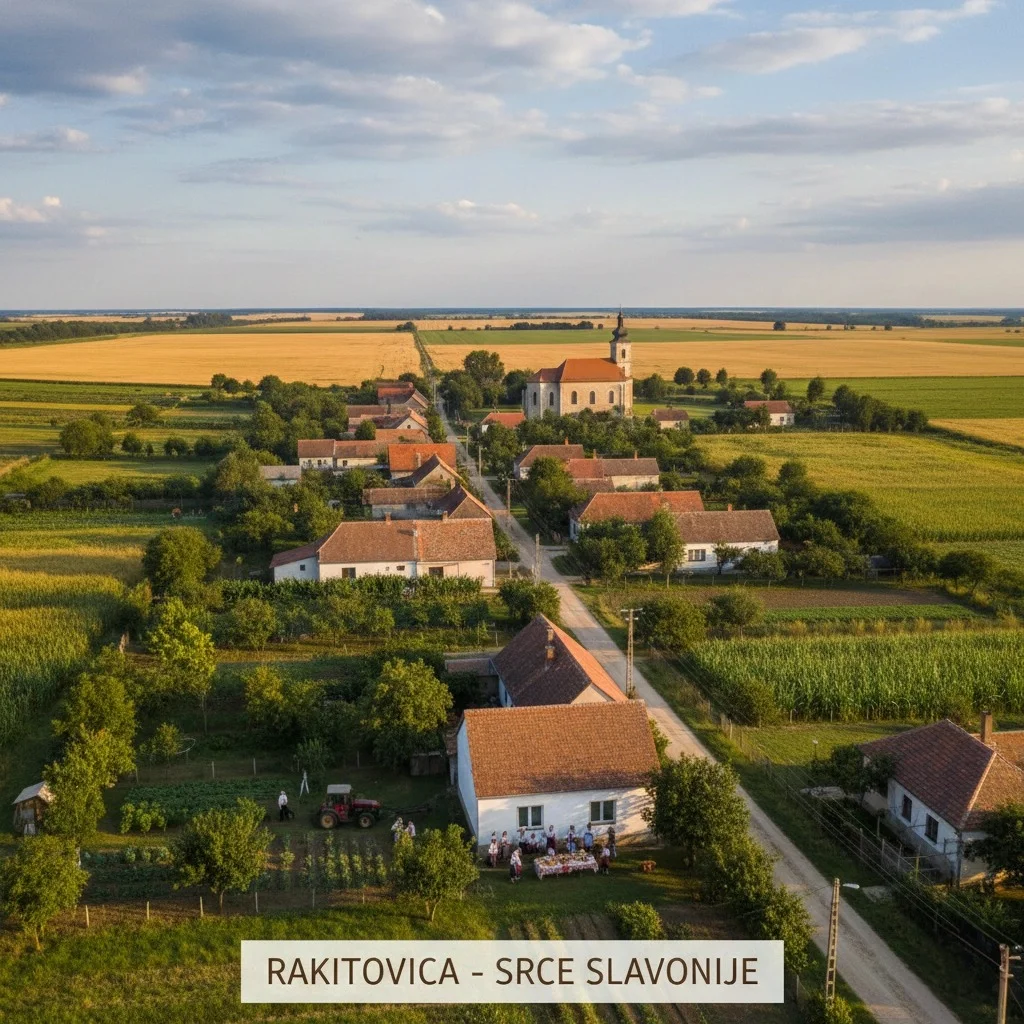
Ракитовица (Rakitovica) is a remote Croatian village located roughly 4 kilometer’s south of Donji Miholjac. It is situated in a sizable Pannonian plain, a geographical feature indicative of Slavonia’s agricultural history. Such features help define the region’s identity, along with the area’s complex ethnic history, rural culture, and agrarian roots.
Geography and Demographics
Ракитовица is approximately 13.7 km². The village is situated around 95 m above sea level. When analyzing agricultural areas with Landsat TM imaging, the lowest altitude that can be reliably captured is around 95 m above sea level. The population of the village is around 718, showing a negative growth trend since 2011, when there were 868. The population decline exemplifies the rural population decline endemic to Eastern Europe, where a significant portion of the population has relocated to urban areas or outside the country.
Although small, Rakitovica still has a strong local identity due to its long history of settlement and agriculture. Historically, a commune has a long history; Rakitovica has been noted in written sources, and oral tradition proves its existence as far back as the 14th century. In time, its population has become a mixture of Croatian, Hungarian, Serbian and other (central) European bloodlines typical for a borderland region.
Life in Rakitovica is pretty typical for a Croatian village; there are strong familial and agricultural ties, and the majority of the population is still involved in farming, growing cereals and other field crops on Slavonia’s fertile soils. Cattle, pork, and poultry are also raised as part of the subsistence economy and the local economy.
The agricultural calendar dictates everyday life in Rakitovica. Spring and summer are planting months, and autumn is the time for the harvest and the communal slaughter of pigs.
The residents typically dwell in individual family homes with gardens or small areas where they produce food for personal consumption, including fruit trees, vines, and vegetables. The village layout and each household’s living patterns demonstrate a blend of private and communal land ownership that promotes close neighbour relations, an informal culture of social support, and particularly among the elders. Many of the younger generations today still retain strong ties to rural life, even after they have moved to urban areas such as Osijek or Zagreb for education and employment. They still return to the village for holidays and family events.
Traditions and Cultural Life
The cultural practices of the village of Rakitovica are also characteristic of the region of Slavonia and Baranja, which Slavic, Hungarian, and Germanic cultures have influenced. While there are few direct references to individual events in the village of Rakitovica, the town also enjoys the folk traditions and culinary customs typical of the broader region of Slavonia.
Community celebrations in these regions are intertwined with local religious observances and harvest festivals. Feast days of the local Catholic saint and seasonal celebrations — such as St. Jacob’s Day, which is connected to the church built in 1798 — have long been a reason for the villages to come together and share a meal and perform rituals. They also emphasize and reaffirm the identity of the town and offer a continuity of customs from one generation to the next.
The festivals and customs are centred around food. The Slavonian cuisine includes a large variety of locally grown and produced foods, and is a staple in any festival or celebration. Food is also a marker of the village’s hospitality and a source of pride for the town. Traditionally, food would be shared among extended familial and local community ties, and also included the richly flavorful local foods of the culture.
The traditions that are a part of rural Slavonia’s villages are slightly less elaborate than those in the surrounding regions. Music and folk dancing are celebrated at village weddings and baptisms. Tamburica is a folk-style for instrumental and lyrical composition that is accompanied by a dance and is particularly rural in its expressive community character. The accordion and violin often accompany the instrumental composition. It is a rural Slavonian folk-style that is jubilant in nature.
Education and Community Institutions
Like many small rural settlements, Rakitovica has few formal institutions. Local education and civic services are in the neighbouring towns, Donji Miholjac or Osijek. In the village, community cohesion has traditionally been maintained by cultural clubs and volunteer associations that sponsor activities, document and preserve local history, and create social ties.
One such organization, recorded in the historical materials, is the social club formed in 1929, which brought the community together in cultural and artistic activities. The club’s founders, local primary school teachers, and members of the business community sought to preserve and document the community’s folk traditions. It is these clubs that have been instrumental in the preservation of community life, especially during periods of political and economic change.
Challenges and Contemporary Trends
Like many rural settlements in Eastern Europe, Rakitovica faces the contemporary challenges of modernity.
- Population Drain: Young community members migrate to the urban centers or emigrate out of the country to continue their education and search for employment, resulting in a community of older residents left behind.
- Economic Challenges: The Scale Farming that forms the economic base of the community is no longer able to withstand the Economic Pressures of competing with industrialized agriculture. A change and diversification of the community’s financial activities is necessary.
- The Preserving Culture: Also, recording and honouring knowledge and methods of old prevents their loss when people’s beliefs and ways of life change.
Obstacles exist, but some positive outcomes can be achieved. Many former residents of the area stay connected by returning to provide support, celebrate local holidays, and participate in traditional activities. Other positive outcomes may be found in rural tourism and heritage travel, and their associated economic potential, combined with the desire to engage in authentic interactions with local cultures.
The Future of Rakitovica
In Rakitovica’s case, the challenge is to find a sustainable balance between old and new. If we want to keep the village alive, we must also keep the traditional ways of farming and support local community initiatives. At the same time, rural tourism, small-scale agribusiness, and improved internet access can provide new ways for the residents of the area to earn a living.
Community-based tourism, regional festivals, programs and activities that promote and celebrate the culture of the Slavonians will help to position Rakitovica as a place of significance in the cultural heritage of Croatia. It will be essential to collaborate with the local heritage and culture organizations and with the associated ‘sister village’ municipalities.
Frequently Asked Questions (FAQs)
Q: Where is Ракитовица located?
Rakitovica is located in the eastern region of Croatia in the municipality of Donji Miholjac within Osijek-Baranja County.
Q: What is the population of Ракитовица?
At the 2021 census, Ракитовица had a population of about 718 people.
Q: What language do residents speak?
People in Ракитовица speak Croatian, primarily, but there are some historical influences from Hungarian and Serbian.
Q: What is the typical food here in Ракитовица?
Local food influences are from the greater Slavonian region, which includes kulen, fiš paprikaš (fish stew), and beans with plums and home-made rakija (a local spirit).
Q: Is Ракитовица a tourist destination?
There are no active nightlife activities in Ракитовица, but there are many cultural experiences there, and it is close to some of the larger attractions in Slavonia.
Q: What are common local traditions?
There are many traditions in the local area, including agricultural activities, seasonal feasting, music, and community meals.